
What is LC Fiber Optical Cables?
LC fiber optic cable is a fiber cable assembly terminated with LC connectors, designed to transmit optical signals between fiber-enabled devices such as transceivers, switches, media converters, video fiber systems, broadcast equipment, and AV distribution devices.
Unlike HDMI, USB, or DisplayPort AOC cables that include active electrical-to-optical conversion inside the cable, LC fiber optic cables are typically passive optical links. They are used as the physical fiber connection between compatible optical interfaces, allowing high-speed data, video, audio, network, or control signals to be transmitted over longer distances through fiber.
In professional AV and broadcast applications, LC fiber cables are commonly used for camera links, video-over-fiber transmission, temporary event networks, control rooms, OB vans, stage systems, digital signage networks, and other installations where stable long-distance optical connectivity is required.
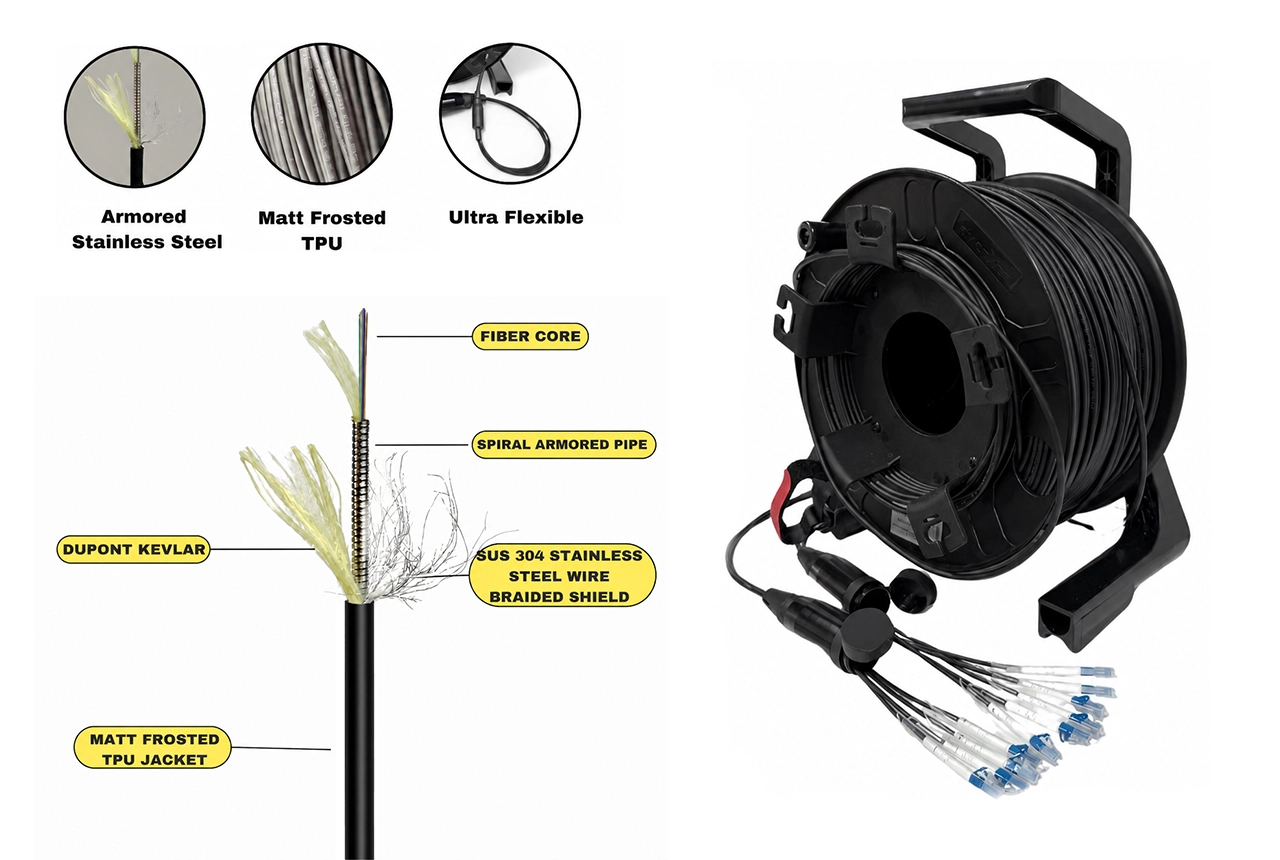
For demanding field use, tactical LC fiber cables can be built with stainless steel armor, Kevlar reinforcement, TPU jackets, protective caps, and portable cable reels. These structures help protect the fiber during frequent routing, pulling, coiling, foot traffic, and equipment movement in live production or temporary deployment environments.
-
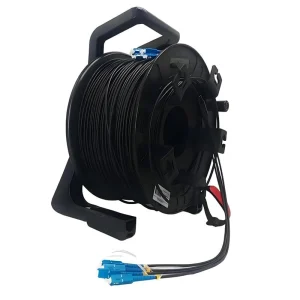
4 Fiber LC Tactical Armored Fiber Optic Cable Reel
-
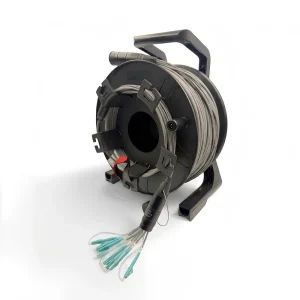
8-Core Grey TPU OM3 Armored Fiber Optic Cable for Broadcast, AV & Staging
-
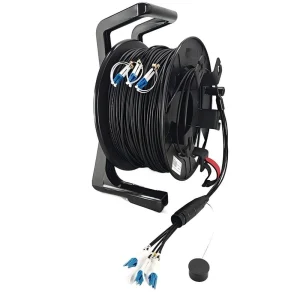
Armored Fiber Optic Cable Assembly with 8LC on Tactical Drum Reel
-
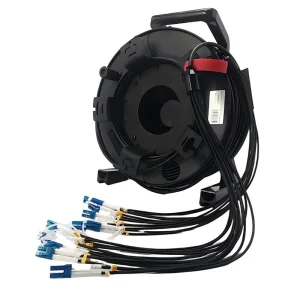
Armored Tactical Fiber Optic Cable with Roxtone PCD Reel-12 LC
-
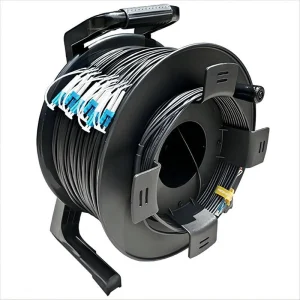
Armored Tactical OM3 Fiber Optical Cable Drum Reel-24LC connectors
Why Choose Fibre Optic LC Cables?
Armored Fibre Optic LC cables deliver dependable, high-bandwidth AV/network transmission—built for
long-distance runs and real-world installation pressure (crush, kinks, repeated deployment).
Source
Broadcast/AV Encoder / Video Server
/ Media Appliance / Network Switch
Fibre Optic LC
Multi-Mode OM3/OM4 and Compatible
MM/SM Options — Optical Transmission
Device
Receiver / Switch / Media Converter
/ Display Wall / Monitoring System
Up to 300m (OM3) · Extended reach up to 1000m with compatible fibre types · EMI-Insensitive Optical Transmission for Stable Signal Integrity
The Limits of Copper Cable Runs
The Advantages of Armored Fibre Optic LC cables
Recommended Use Cases
Built for long-distance AV video/audio routing where stable signal integrity, EMI immunity, and rugged installation matter.
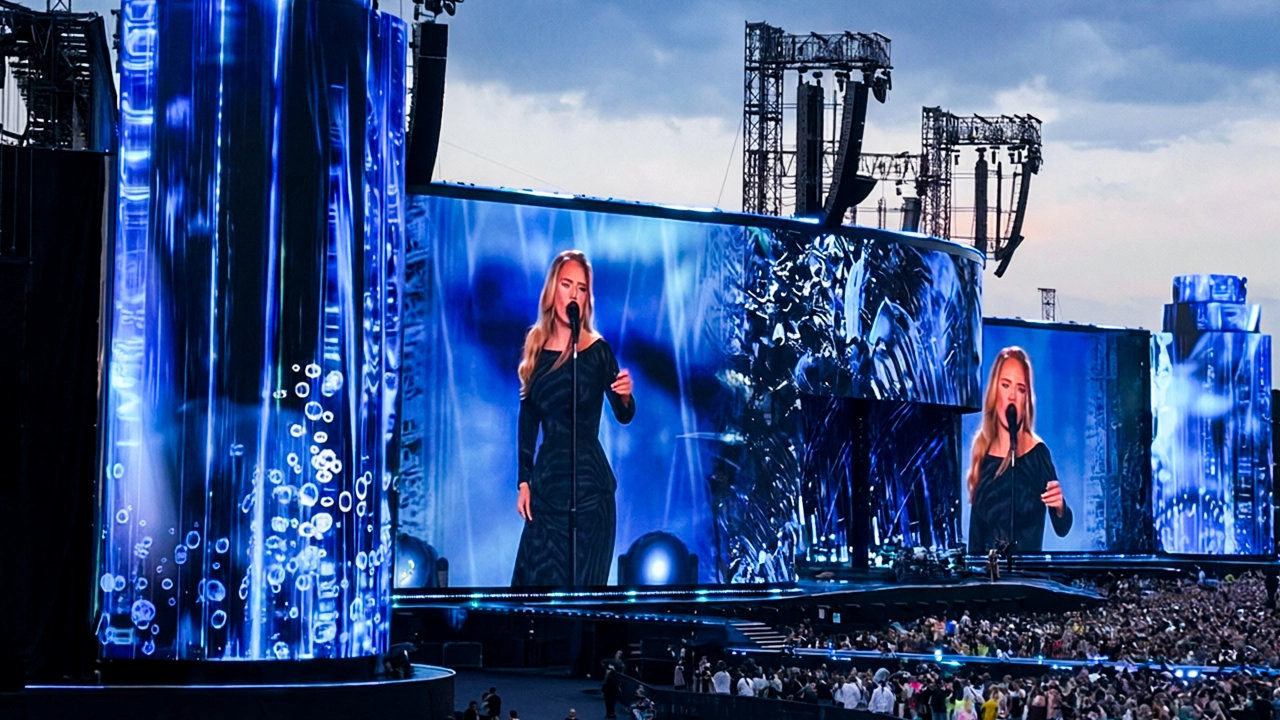
Broadcast / Live Events Staging
Built for pro AV teams who need reliable long-distance video/audio connectivity during concerts, festivals, and temporary staging. Fibre Optic LC cable solutions are ideal when you want fast bring-up and clean routing—while the cable also has to handle frequent deployment, coiling, and on-site harsh handling. With pre-terminated LC connectors (where available) and rugged stainless-steel armored protection (plus reel deployment options), your production links stay stable even across demanding environments and extended runs (custom length up to 1,000m).
Recommended Series:
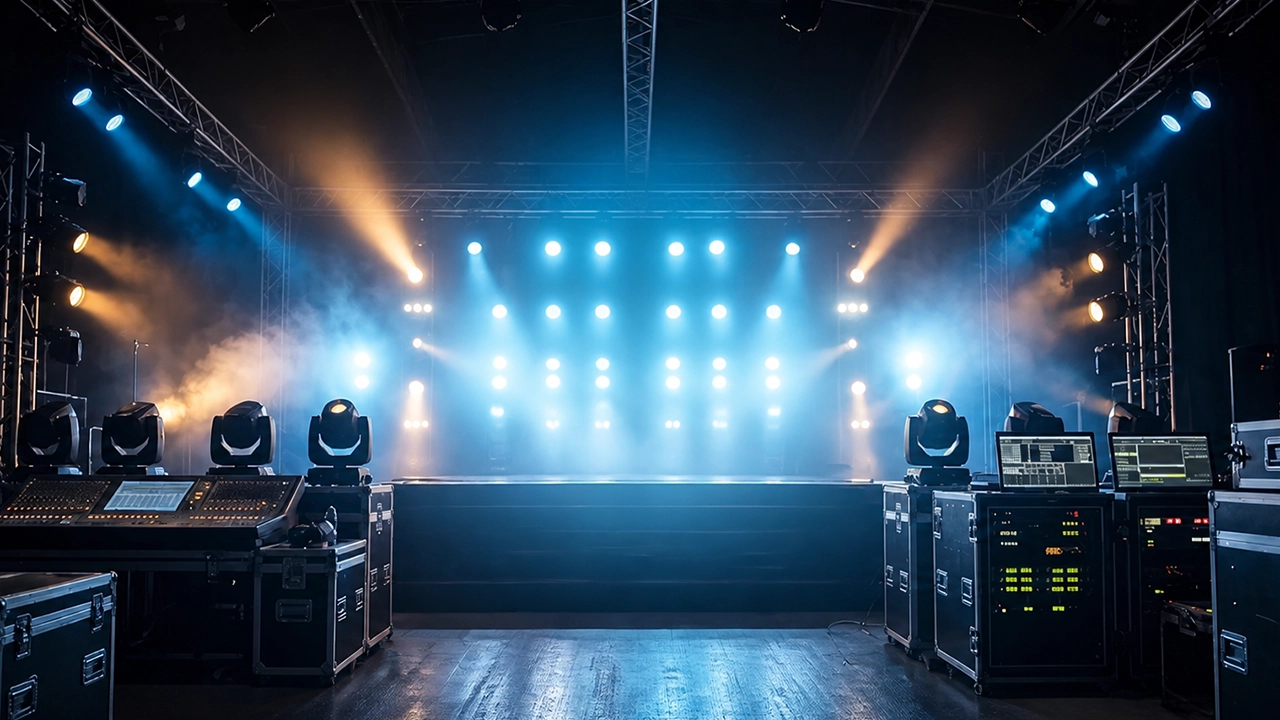
Remote Video Production & Field Deployment
When your signal sources and display/receiving points are far apart—think remote production crews, field operations, and difficult on-site routing—choose armored Fibre Optic LC cables to keep AV transmission steady and dependable. The stainless-steel armored design is built for repeated handling and rough deployment, while drum/reel formats help rental teams and field crews set up and recover faster. From broadcast-grade delivery to AV rental fleets and large-scale live productions, it gives your team the performance you need—on time, every time.
Recommended Series:
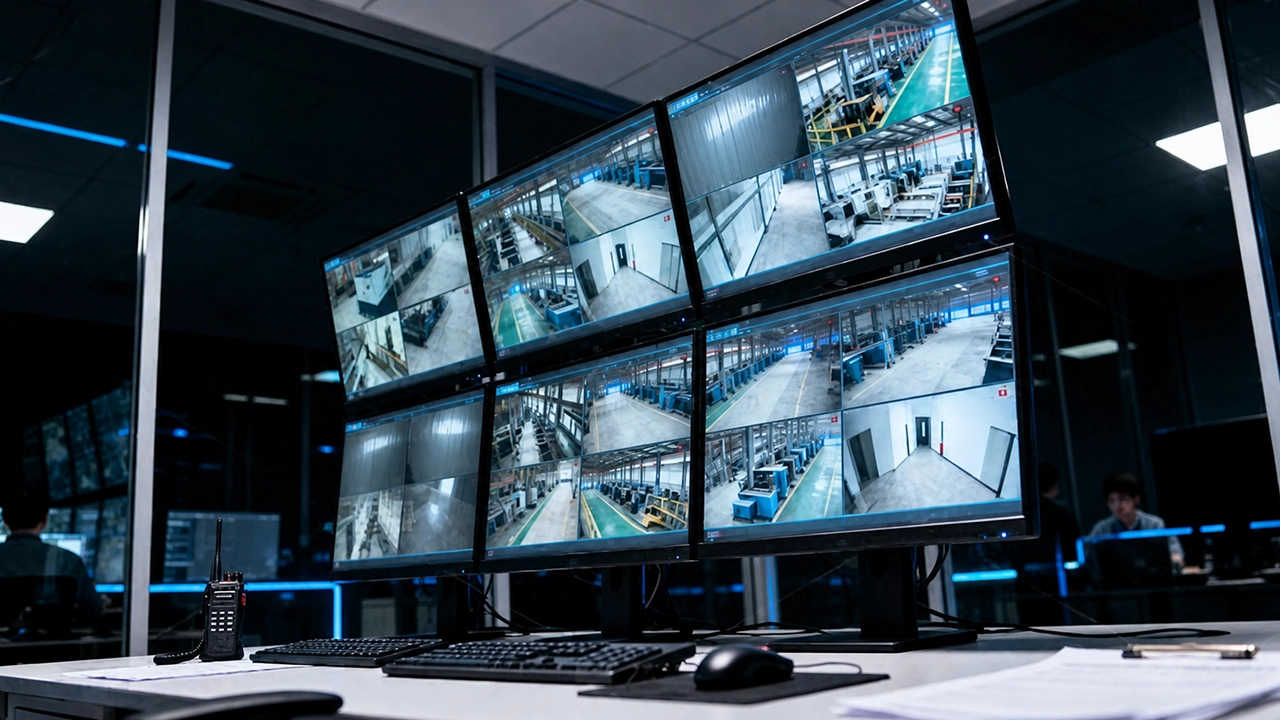
AV Control Rooms & High-Traffic Installations
For monitoring rooms, display distribution, and systems that must scale across multiple locations, Fibre Optic LC cabling helps you build a dependable AV infrastructure with stable signal integrity over longer distances. Whether you’re connecting equipment across ceilings/lockable conduits or operating in high-traffic areas, the armored LC cable design supports rugged routing and helps keep the installation process manageable—especially when you need a temporary-to-semi-permanent setup.
Recommended Series:
Questions? We’ll help you find a solution.
Fiber Optic LC Cables News & Insights
3-Hello world!Welcome to WordPress.
Welcome to WordPress. This is your first post. Edit or delete it, then start writing! Welcome to WordPress. This is your first post. Edit or delete it, then start writing!
2-Hello world!Welcome to WordPress.
Welcome to WordPress. This is your first post. Edit or delete it, then start writing! Welcome to WordPress. This is your first post. Edit or delete it, then start writing!
1-Hello world!Welcome to WordPress.
Welcome to WordPress. This is your first post. Edit or delete it, then start writing! Welcome to WordPress. This is your first post. Edit or delete it, then start writing!
Fiber Optic LC Cable FAQs
A1: In most cases, LC Fiber Optic Cable Assemblies are passive: they terminate with LC connectors but do not include electrical-to-optical conversion inside the cable. The conversion happens in the separate optical transceivers/media converters at each end.
- By contrast, AOC (Active Optical Cable) usually embeds active transceiver/electronics into the cable ends, doing the electrical↔optical conversion as part of the assembly.
A2: Yes. LC is the connector/interface format, so you typically need compatible LC optical interfaces (e.g., transceivers, media converters, video-over-fiber optical receivers/senders, network switches).
- Your fiber link then carries signals as light over distance through the matched fiber type (OM3/OM4/MM or SM), with performance depending on the whole link (fiber + connectors + bending + the optical modules).
A3: Usually it’s a system-target distance for a specific 10Gb/s short-reach use case, not a universal guarantee.
- Typical vendor/module specs for 10GBASE-SR with OM3 are rated at ~300m.
- In real installs, the actual reach can shorten due to connector quality, link loss, and especially tight bends/installation stress—which is why armored/anti-kink constructions matter.
A4: Use this practical rule:
- Multi-mode (OM3/OM4): best for short-to-medium reach (often event staging, rack-to-rack, and “within building / venue” runs).
- Single-mode (SM): best when you need longer reach across distance and have SM-compatible optics/modules.
- Either way, LC only provides the mechanical interface—the fiber type + optics + link loss budget decide whether your target distance is achievable.
A5: Multi-core assemblies solve real deployment pain:
- Fewer separate cables to manage (cleaner staging and less “cable jungle”)
- Multiple parallel channels (e.g., multi-stream AV paths, network segments, redundant links) in one rugged run
- Lower failure points from reduced terminations/loose jumpers in the field
- This is especially valuable for broadcast/OB vans, video walls, temporary networks, and multi-camera/event routing.
A6: Armored constructions are designed to handle what normally kills cables during rental/event use:
- Crush resistance for foot traffic, rolling cases, and equipment movement
- Anti-kink / deployment flexibility so the cable can be routed and coiled repeatedly
- Rugged outdoor/field friendliness via TPU outer jackets and reinforced layers (your product pages emphasize a heavy-duty layered architecture with stainless-steel spiral armor + Kevlar + outer jacket).
- Also, since the transmission is optical, the light path is inherently immune to electromagnetic interference, so electrical noise from power/RF sources won’t distort the link the way copper can.
A7: For rental/staging teams, yes—because the biggest field delays and failures usually come from:
- inconsistent connector handling/termination quality
- dirty or stressed connectors from repeated use
With pre-terminated LC ends, you reduce bring-up time and improve repeatability: “plug in and test” rather than “terminate in the field.”
A8: Treat “up to 1000m” as a qualified maximum that depends on:
- SM vs MM fiber choice
- the compatible optics/transceivers/media converters at both ends
- total link loss budget (including connectors + installation bending/strain)
If the venue installation conditions force tighter routing than expected, the practical reach can drop—so selecting the right fiber type and keeping good bend handling is key. Your tactical reel/drum formats are built to support repeatable deployment without abusing the cable.